The successful completion of the BIORISKS project and its key achievements
Article Overview
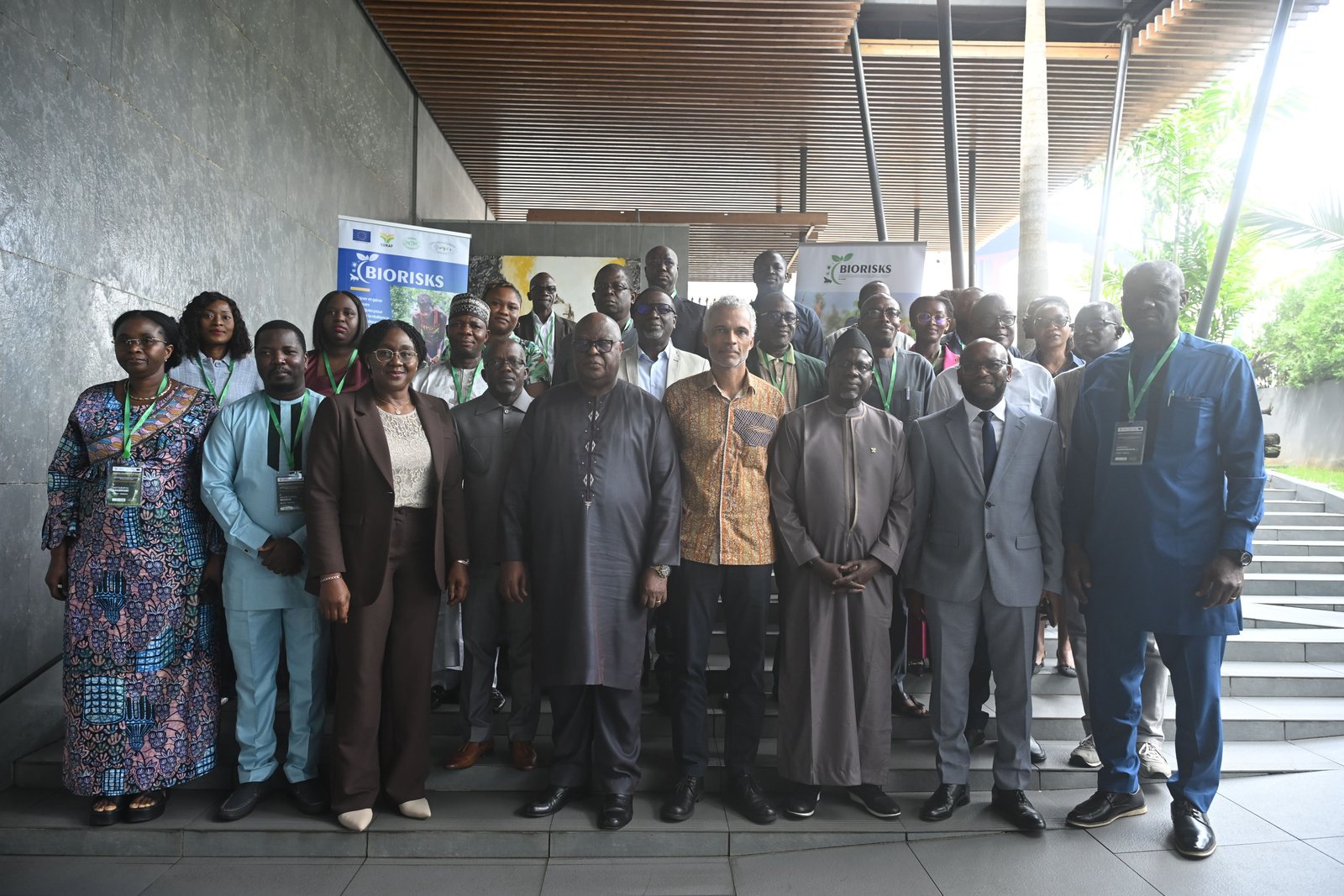
After five years of implementation, the BIORISKS project officially ended at a regional closing workshop held in Abidjan.
After five years of implementation, the BIORISKS project officially ended at a regional closing workshop held in Abidjan. This meeting brought together the main actors of the project, including representatives of the ten beneficiary countries, technical and financial partners, researchers and implementing institutions.
Coordinated by CORAF and funded by the European Union, the project was implemented with the support of the WAVE Regional Centre of Excellence in ten countries in West and Central Africa: Benin, Burkina Faso, Cameroon, Côte d'Ivoire, Gabon, Ghana, Nigeria, Democratic Republic of Congo, Sierra Leone and Togo.
In the face of increased trade, the increasing circulation of pests and the effects of climate change, the BIORISKS project aimed to strengthen regional capacities to anticipate, monitor and manage biological risks threatening strategic food crops.
A regional response to threats that know no borders
For Professor Justin Pita, Executive Director of the WAVE Regional Centre of Excellence, one of the main lessons of the project is the need to adopt a regional approach to transboundary plant diseases.
According to him, pests and diseases do not know administrative borders. The fight against these threats can therefore only be effective if countries harmonise their actions, share information and coordinate their response mechanisms.
This vision has been translated into concrete action in the development of national response plans in the ten participating countries that allow the authorities to have clear protocols to quickly detect and contain any new disease incursions.
Professor Pita also recalled that plant health is now a key pillar of the One Health concept. Alongside human, animal and environmental health, crop health represents a major challenge for the food and economic security of populations. Healthy plants ensure sustainable agricultural production, which is essential for food security and improved incomes for producers.
Concrete results for producers
At the end of the project, awareness-raising activities, demonstration plots and simulation exercises directly reached more than 3,239 agricultural stakeholders. Of these, 37% were women.
The project also trained 1,460 people in the use of the PlantVillage Nuru digital app, 51% of whom were women and 27% of whom were youth. To support the deployment of this innovative tool, 260 smartphones have been distributed in Cameroon, Gabon, the Democratic Republic of Congo and Sierra Leone.
Nineteen demonstration plots have been established to promote good agricultural practices and improve producers' ability to recognize crop diseases early.
These actions contributed to the improvement of the incomes of small-scale producers in the six participating countries and to the creation of 1,131 jobs, of which 29% were held by women and 34% by young people.
During the closing workshop, Emmanuel Njukwe, Director of Research and Innovation at CORAF, highlighted that BIORISKS had facilitated the use of innovative tools to improve the early detection and management of plant diseases.
Initially designed for cassava, these tools have gradually been adapted to other economically important crops such as plantain, maize and several other agricultural crops. With these technologies, growers and technical services can now identify diseases faster, share warnings and strengthen prevention measures at the regional level.
The project also promoted the creation of national databases for the collection, processing and sharing of phytosanitary information between participating countries.
Investing in science to ensure sustainability
In addition to tools and infrastructure, BIORISKS has invested heavily in human capital to ensure the sustainability of the gains.
Thirteen doctoral students, 38% of whom were women, were recruited and trained in the fields of virology and sociology. To date, six theses have been defended and twelve scientific articles published.
For Emmanuel Njukwe, this new generation of researchers is one of the major legacies of the project. Strengthening local scientific capacity will enable countries to continue their efforts and ensure the continuity of biorisk monitoring and management systems well beyond the duration of the project.
The capacities of WAVE's laboratories have also been strengthened through the acquisition of modern diagnostic equipment and kits, improving the detection and characterization capabilities of emerging diseases.
Strengthened policy dialogue for better phytosanitary governance
The project also gave an important place to political dialogue and regional cooperation.
Several high-level workshops brought together Ministers of Agriculture, representatives of ECOWAS, CORAF, the WAVE Regional Centre of Excellence, regional hubs as well as technical and financial partners. These meetings have promoted the exchange of experiences, the sharing of scientific results and the formulation of recommendations aimed at strengthening phytosanitary surveillance and healthy seed management policies.
This dynamic has made it possible to harmonize sampling and diagnostic protocols while consolidating regional preparedness and response mechanisms to phytosanitary threats.
A lasting legacy for regional food security
BIORISKS leaves behind much more than numerical results. The project contributed to building a more efficient regional surveillance network, strengthening scientific and technical skills, promoting the use of innovative digital tools and improving coordination between countries in the face of biological threats.
As the challenges of climate change and the emergence of new pests continue to intensify, the achievements of BIORISKS now provide a solid foundation for the sustainable protection of agricultural systems in West and Central Africa.
The experience gained over these five years demonstrates that a regional response, based on science, innovation and cooperation, remains one of the best guarantees to preserve plant health, strengthen food security and support the livelihoods of millions of producers.
Contact Information
Share This Article
Quick Actions
Our Presence
WAVE RESEARCH operates regional hubs and offices across Central and West Africa to effectively coordinate research, participatory surveillance, and early warning systems.